SAO: learn from individual rollouts
Single-Rollout Asynchronous Optimization (arXiv:2607.07508) samples one rollout per prompt and grades each on its own. A scored rollout joins the next optimizer step without waiting for siblings, and the next attempt runs on the weights that step produced.
|
Evolves |
model weights |
|
Signal |
one report with a finite score per rollout |
|
Loss family |
sao |
|
Package |
recipes/sao/ |
|
Pipeline |
reported feedback, singleton |
|
Needs |
GPUs, and a backend that captures tokens and log-probs |
|
Example |
recipes/sao/examples/imo_answerbench/ |
What it does #
SAO has no comparison group. A rollout is accepted as soon as its score arrives, without waiting for siblings and without a barrier, and batch_size accepted rollouts from as many prompts form one optimizer step. It can be used for a stream of tasks where each attempt gets its own score.
How Reef implements it #
The record-to-task stage turns every eligible ScoredRolloutReport into one TrajectoryItem. "Single rollout" means one rollout per prompt, with no comparison group; batch_size such rollouts, from different prompts, form one optimizer step. The default is the paper's 128. Setting it to 1 makes every sample its own training step, which is convenient for a smoke run but is not the paper's estimator: the value model needs a full batch per step to learn, and without it the single-sample advantages are noise. The sao loss family runs Slime's policy_loss with SAO's per-token primitive and a critic colocated on the actor GPUs. The critic supplies the values, and skip-observation GAE builds the advantages inside the training backend.
The DIS ratio compares the current policy against the log-probabilities recorded when the rollout was generated. SAO therefore requires an inference backend that attaches engine-native tensors.
The value model carries the paper's cold-start mitigations: it trains at its own, higher learning rate (--critic-lr) and the first --num-critic-only-steps optimizer steps fit the zero-initialized value head before any policy update. Warmup steps still commit one training release per step; the policy's weights first move after the warmup.
Configuration #
SAO's pipeline has three stages: ExclusiveReportRecord2Record, SAOTasks, and SAOBatches. The deployment's pipeline section configures them. The record stage takes no config. Set the batch size in the batch stage's config:
recipe:
  implementation: recipes.sao.recipe:SAORecipe
  config:
    max-staleness: 18
pipeline:
  task2batch:
    config:
batch_size: 8 # MUST equal training.config.global_batch_sizepipeline.task2batch.config.batch_size128rollouts (one per prompt) per optimizer step; the paper's value. Must equal the driver's --global-batch-size because each sample is its own data-parallel unit. 1 trains on every rollout as it lands and is a smoke setting only.pipeline.record2task.config{}the sample-assembly keys: accept_multi_turn_policy_samples (default false) trains a report that references several model calls as one multi-turn sample; realign_threshold (1024) and scaffold_tolerance (0) bound the tokens that assembly may realign.recipe.config.max-staleness0accepted lag between the producing and serving version.Reef checks the stage configs when it loads the recipe. A batch-size key in recipe.config stops the deployment with a message that names its new place, pipeline.task2batch.config.batch_size.
Run the example #
The example runs three IMOAnswerBench problems in order on a two-GPU stack. For each problem the agent makes six attempts through Reef, extracts the \boxed{} answer, then checks it against the gold answer for a binary reward and finally reports the result against its receipt. The next problem is served by the weights the previous one produced.
cd recipes/sao/examples/imo_answerbench
pip install -e . "reef-eval[harbor]"
hf download Qwen/Qwen2.5-1.5B-Instruct --local-dir ~/models/Qwen2.5-1.5B-Instruct
./run.sh
run.sh starts the stack that serve.yaml describes: one Megatron actor with the critic colocated on it and one SGLang rollout engine. The smoke config sets pipeline.task2batch.config.batch_size to 1, so each scored rollout adds one training entry to the scenario's version chain:
curl -sS -H "Authorization: Bearer reef-local" \
  http://127.0.0.1:8900/reef/scenarios/sao-smoke/releases
# {"scenario": "sao-smoke", "releases": [{"operation": "training", "current": true, ...}, ...]}
The runtime reports pg_clipfrac, critic/explained_variance, actor and critic grad_norm, and the asynchrony metrics sao/policy_lag_*, sao/queue_age_s_*, and sao/effective_token_rate.
CEO-Bench #
The CEO-Bench example trains the same recipe on CEO-Bench, a 500-day simulated startup. The harness is the benchmark's own bash agent played from the host, its prompt, tools, and tool executor taken from the pinned checkout in the task image and its model calls served by Reef; the two simulator roles stay outside Reef, and the verifier reads final cash, survival days, and bankruptcy from the run's world.nmdb. The reward is weekly and online: when the next week's dashboard appears, the finished week's decision turns (the tool calls that changed the company) are reported with the week's credit, its change in company value (cash plus the engine's subscription run-rate over the weeks left) and the discounted changes of the weeks after it, scaled against the weeks before, so the recipe trains while the episode runs. The example's README records the reward-shaping choices and the recorded episodes.
cd recipes/sao/examples/ceobench
hf download Qwen/Qwen3.6-27B --local-dir ~/models/Qwen3.6-27B
export ANTHROPIC_API_KEY=...        # the simulator roles' provider
CEOBENCH_DAYS=500 CEOBENCH_SEED=42 ./run.sh
Results #
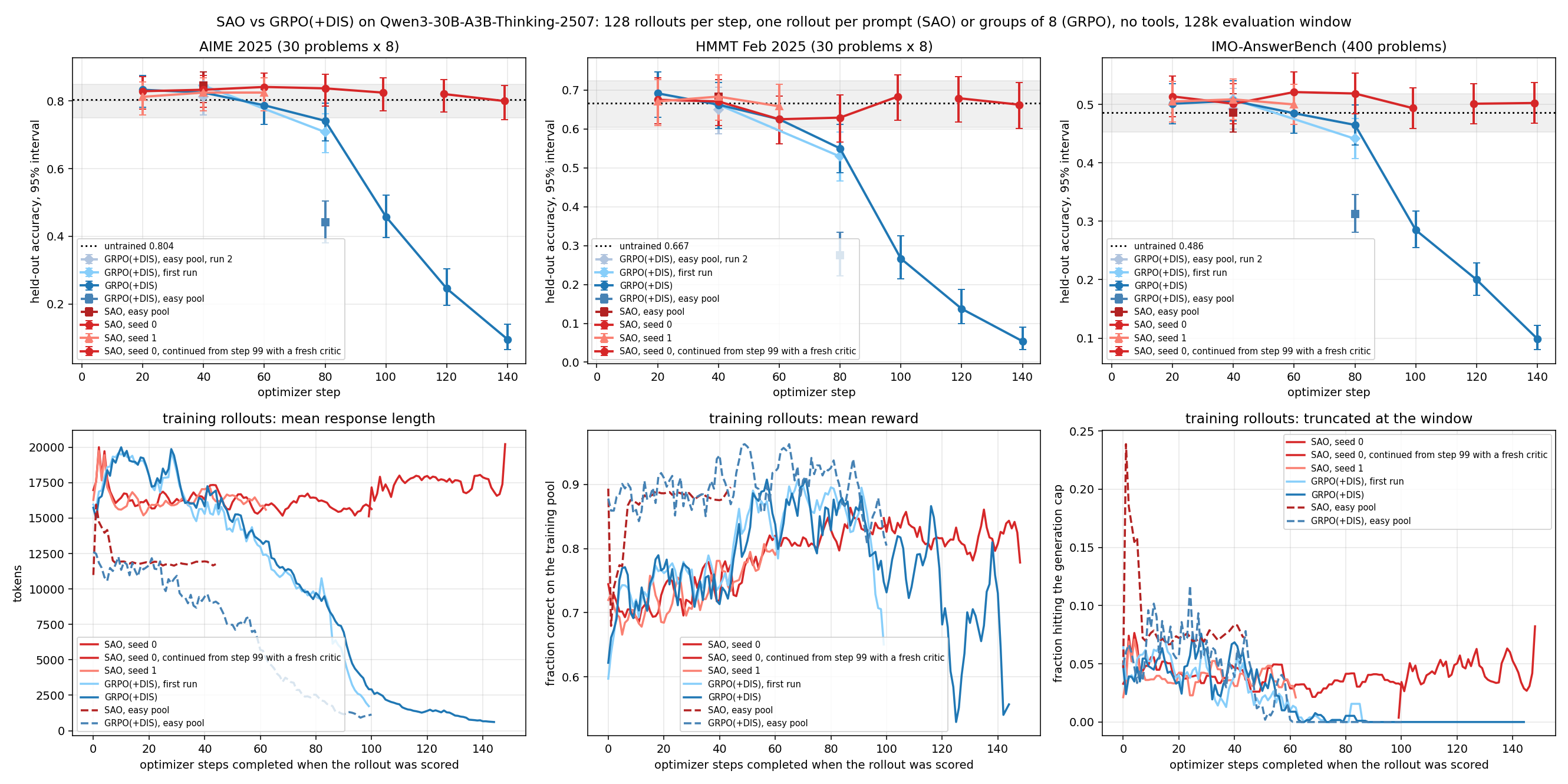
The example's README records the batch-128 comparison on Qwen3-30B-A3B-Thinking-2507: SAO and a GRPO(+DIS) control trained from the same public checkpoint on a DeepMath pool, without tools, and evaluated on held-out AIME 2025, HMMT February 2025 and IMO-AnswerBench. The control is a reported baseline, not a shipped recipe. SAO trained stably for 99 steps and gained 2 to 4 points on AIME and IMO-AnswerBench, within per-checkpoint intervals. GRPO(+DIS) matched it through step 40, then shortened its responses and fell 5 to 13 points below SAO by step 80 and to a fraction of the base rate by step 140. The README lists the numbers and the distance from the paper's tool-integrated setting.
Related guides #
-
Inference and feedback quickstart: learn the request, receipt, and report workflow.
-
Train model weights from agent feedback: set up the GPU stack and inspect published updates.
-
HTTP API reference: connect your agent and query feedback, scenarios, and releases.