Guidance-TTT: train the guide, keep the executor frozen
Guidance-TTT trains a small model to propose improvements to a candidate program. A frozen execution model turns each proposal into code. A task judge evaluates that code, and Reef uses the score to update the guidance model. Only the guidance response contributes tokens to the training batch.
The example includes Polyomino Packing, Lasso Path, AHC058, and TriMul. These tasks cover packing, numerical solvers, planning, and GPU kernels.
|
Evolves |
Guidance-model weights |
|
Signal |
One finite reward linked to each guidance receipt |
|
Loss family |
tttd |
|
Package |
recipes/tttd/ |
|
Needs |
Linux, training GPUs, Docker, a frozen executor, and a task judge |
|
Example |
recipes/tttd/examples/guidance_ttt/ |
How one step runs #
The guidance model sees the parent's canonical summary, not its source code. The executor sees the source code and the new guidance. It returns a complete program and a replacement summary for later steps.
Each guidance response must end with one nonempty <guidance> block. Malformed guidance receives zero reward without an executor call. The harness does not resample guidance to repair its format.
The archive admits valid programs and ranks them by the task's raw metric. The optimizer receives a nonnegative reward. TriMul, for example, minimizes latency while its training reward is 1500 / latency_us.
Choose a task #
|
GUIDANCE_TASK |
Candidate |
Judge and metric |
|---|---|---|
|
polyomino_packing |
C++17 program |
FrontierCS problem 0, 70 cases, packing score increases |
|
lasso_path |
Python wrapper containing C++17 CPP_CODE |
SimpleTES, 17 cases, inverse geometric-mean solve time increases |
|
ahc058 |
C++20 program |
TTT-Discover's 150 public cases, mean raw score increases |
|
trimul |
Python module with Triton kernels |
18 correctness tests and seven H100 timing cases, latency decreases |
Each task has its own instruction, contract, bootstrap, verifier, scenario, and state directory. The shared harness uses the same guidance loop for all four tasks.
Run an example #
Install Reef's GPU dependencies as described in Installation. From the repository root, install the client and example:
git submodule update --init third_party/reef-client
python -m pip install -e ./third_party/reef-client
python -m pip install -e . -e recipes/tttd/examples/guidance_ttt
cd recipes/tttd/examples/guidance_ttt
Select a task and prepare its pinned bootstrap:
export GUIDANCE_TASK=lasso_path
python prepare.py "$GUIDANCE_TASK"
Start its judge using the evaluator instructions. Set both judge addresses if you change the default port or host:
export GUIDANCE_JUDGE_URL=http://127.0.0.1:8082
export GUIDANCE_JUDGE_CONTAINER_URL=http://host.docker.internal:8082
The first address is for the host harness. The second is for the final Harbor verifier inside Docker. Polyomino defaults to port 8081. The other tasks default to port 8082.
Choose the frozen executor:
# A separately served GPT-OSS-120B endpoint:
export GUIDANCE_EXECUTOR=local
export GUIDANCE_EXECUTOR_URL=http://127.0.0.1:8000/v1

# Or GLM-5.2 through OpenRouter:
export GUIDANCE_EXECUTOR=openrouter
# Supply OPENROUTER_API_KEY through your environment or credential store.
For a bounded smoke run, set GUIDANCE_EXECUTOR_MAX_TOKENS=16384. Without this setting, the executor provider selects its default output limit.
Start the example from a GPU allocation:
./run.shThe default configuration runs one update with two groups of four rollouts. It downloads Qwen3-8B once, starts Reef, verifies the bootstrap, and runs the selected Harbor trial. It then submits the best archived program for a final verification. The final Harbor reward remains evaluation-only.
The default run checks integration. It does not reproduce the paper's 30-update, 8-by-16 search budget. The local executor also differs from the paper's GLM-5.2 executor.
Configure a search #
serve.yaml owns the grid and training limits. The harness reads the same file, including a file selected through GUIDANCE_CONFIG.
|
Configuration |
Default |
Meaning |
|---|---|---|
|
recipe.config.groups-per-step |
2 |
Parents selected per update |
|
recipe.config.rollouts-per-group |
4 |
Guidance samples per parent |
|
training.options.global-batch-size |
8 |
Must equal groups times rollouts |
|
training.config.steps |
1 |
Total committed updates requested |
|
training.config.max_tokens |
8192 |
Maximum guidance response length |
|
GUIDANCE_MAX_WORKERS |
8 |
Concurrent executor calls |
|
GUIDANCE_MODEL |
Qwen/Qwen3-8B |
Guidance model downloaded by the launcher |
|
GUIDANCE_STATE_DIR |
work/<task> |
Absolute root for records, checkpoints, and the archive |
For the paper budget, set the grid to 8 by 16, the batch size to 128, and the update count to 30. AHC058 and TriMul use Qwen3-14B in the main results. Set GUIDANCE_MODEL=Qwen/Qwen3-14B for those configurations. Model size, context length, and concurrency determine the required GPU memory.
Bootstrap verification uses the same evaluator as search. For your own seed, set GUIDANCE_SEED to its source file. Place a canonical summary beside it with the same stem and a .md extension.
The report contract #
Each report references the receipt from its guidance inference. Its metadata contains step, group, rollout, groups_per_step, and rollouts_per_group. The TTT-Discover guide describes the complete grid contract.
The task judge returns score for training and scoreUnbounded for archive ranking. It also returns valid. An invalid AHC058 program can earn a partial training reward, but it cannot enter the executable archive.
A missing judge, malformed score, or executor service error stops the step. These errors do not become zero-reward training examples. A rejected candidate receives the task's invalid reward and still counts as a PUCT visit.
Four paper results #
The following values come from the paper's main results at commit 709c405. They are historical experiment results, not new measurements of this example. Each configuration uses a frozen GLM-5.2 executor and 30 updates with eight groups of 16 rollouts.
|
Task |
Guidance model |
Reported result |
Evaluation |
|---|---|---|---|
|
Polyomino Packing |
Qwen3-8B |
91.89 |
70-case packing score, higher is better |
|
Lasso Path |
Qwen3-8B |
0.1739 |
Inverse geometric-mean solve time, higher is better |
|
AHC058 |
Qwen3-14B |
850,082,731 |
Submitted solution's AtCoder score, higher is better |
|
TriMul |
Qwen3-14B |
1,129 microseconds |
Seven-case H100 geometric-mean latency, lower is better |
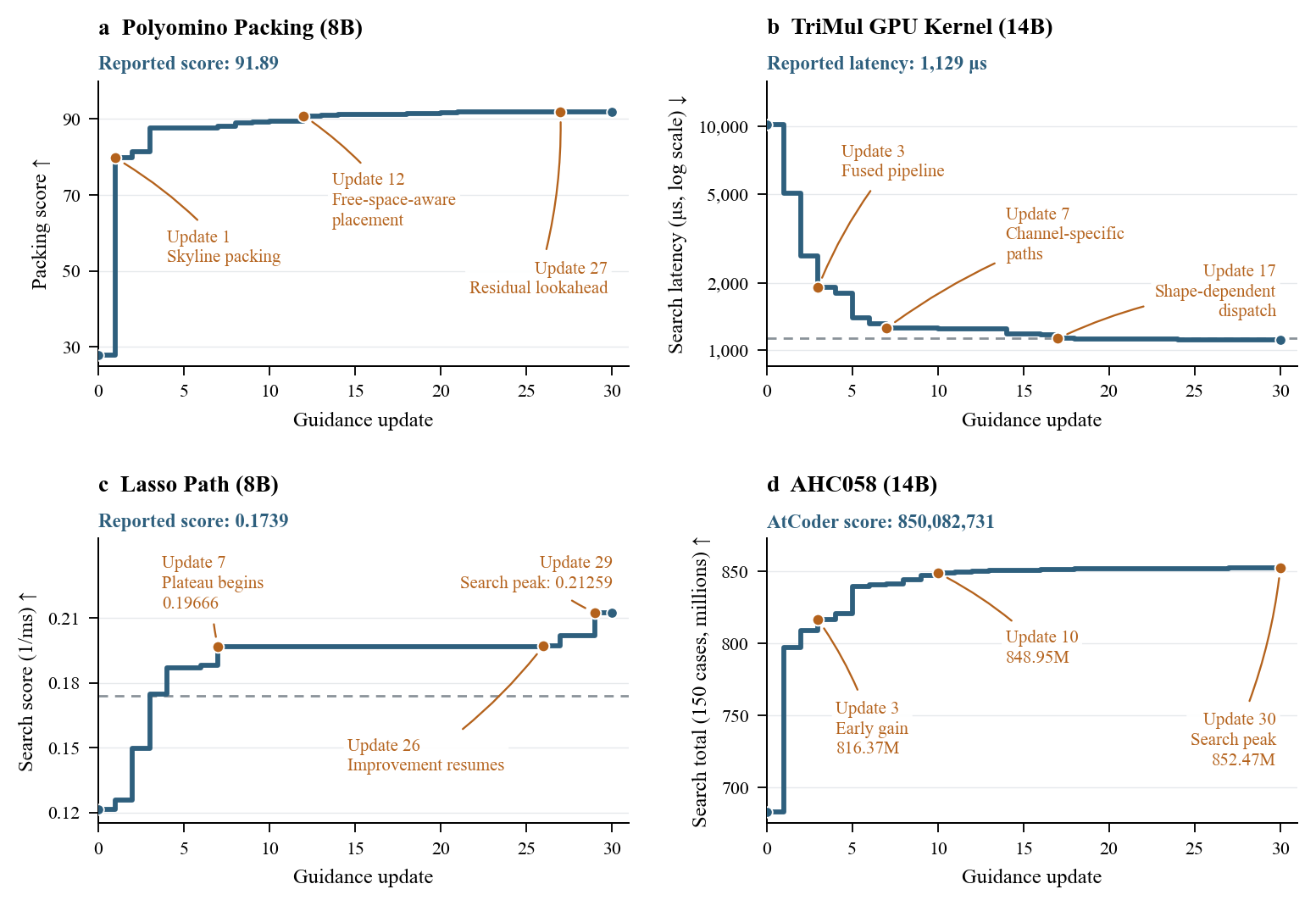
The lines show the best archived solution during search. Search-time measurements and final evaluations use different protocols for some tasks. For Lasso, the search peak is about 0.21259, while the frozen-solver result is 0.1739. AHC058's search curve uses the 150 public cases. Its reported AtCoder score comes from the final submission. TriMul's final value comes from fixed-kernel timing, not the lowest observed search latency.
Polyomino Packing #
The final program scores 91.89 against the paper's human reference of 89.10. CORAL with Opus 4.6 scores 84.20, and TTT-Discover with GPT-OSS-120B scores 83.72. The discovered solver combines skyline packing with reconstruction and simulated annealing over earlier placements.
Lasso Path #
The final score is 0.1739 against 0.1243 for SimpleTES and 0.1368 for TTT-Discover. Both references use GPT-OSS-120B. The solver uses a segment tree to prioritize candidate correlations and avoid repeated scans over inactive features. Every accepted solver must meet the reference objective tolerance of 1e-6.
AHC058 #
The final AtCoder score is 850,082,731. The paper reports 849,325,750 for SimpleTES with GPT-OSS-20B and 848,414,228 for TTT-Discover with GPT-OSS-120B. The discovered policy changes investment phases according to the current state and values the downstream effects of machine upgrades.
TriMul #
The fixed kernel reaches 1,129 microseconds. The paper lists 1,131 for K-Search, 1,261.99 for TTT-Discover, and 1,128 for the eligible GPUMode rank-1 reference. Thus, Guidance-TTT does not beat that public rank-1 result. Its kernel fuses normalization, projection, gating, and layout conversion, then selects a contraction path by input shape.
These comparisons use the models and budgets of their source experiments. They are not controlled comparisons with identical model capacity or cost. The result records include all displayed baseline values, source checksums, and numerical histories.
Inspect progress and resume #
Each task writes reef.log, guidance-run/, checkpoints/, agent-record/, and lab/ under its state directory. The controller waits for the training transaction and adapter publication before it commits the matching archive.
Restart with the same task, model, executor, grid, configuration, and state directory. The controller restores committed-library.json and checks the stored training identity. A changed task contract or executor configuration requires a new state directory.
The default checkpoint interval is one version. Checkpoint availability is separate from archive availability. A saved program alone is insufficient for a full optimizer resume.
Enable experiment tracking #
Set observability.wandb.enabled to true in serve.yaml. Supply the project, optional entity, and credentials through the normal W&B configuration. Experiment tracking describes Reef's tracking behavior.
The recipe records tttd/reward_mean, tttd/reward_max, and grid metrics. These rewards describe the training batch. Use the committed archive's raw score for the best discovered program, especially when the reward is normalized.
Add another task #
Add a directory under harbor/ with an instruction, contract, bootstrap source, environment, and final verifier. Register its name and timeout in harness/config.py. Implement a judge that returns a finite training reward, the raw metric, and candidate validity. Add contract and invalid-output tests before a GPU run.
Related guides #
-
TTT-Discover: the grouped objective and training transaction.
-
Train model weights: the GPU runtime.
-
Example README: evaluator setup and local checks.